
The AI IDE you can actually govern.
Knotic gives every developer Context Lens to inspect payloads before they send, no time-window rate limits, and BYOK for private inference. Teams get repo-native memory, Skills as Code, multi-provider routing, and per-call telemetry to govern AI delivery end-to-end.
Architect
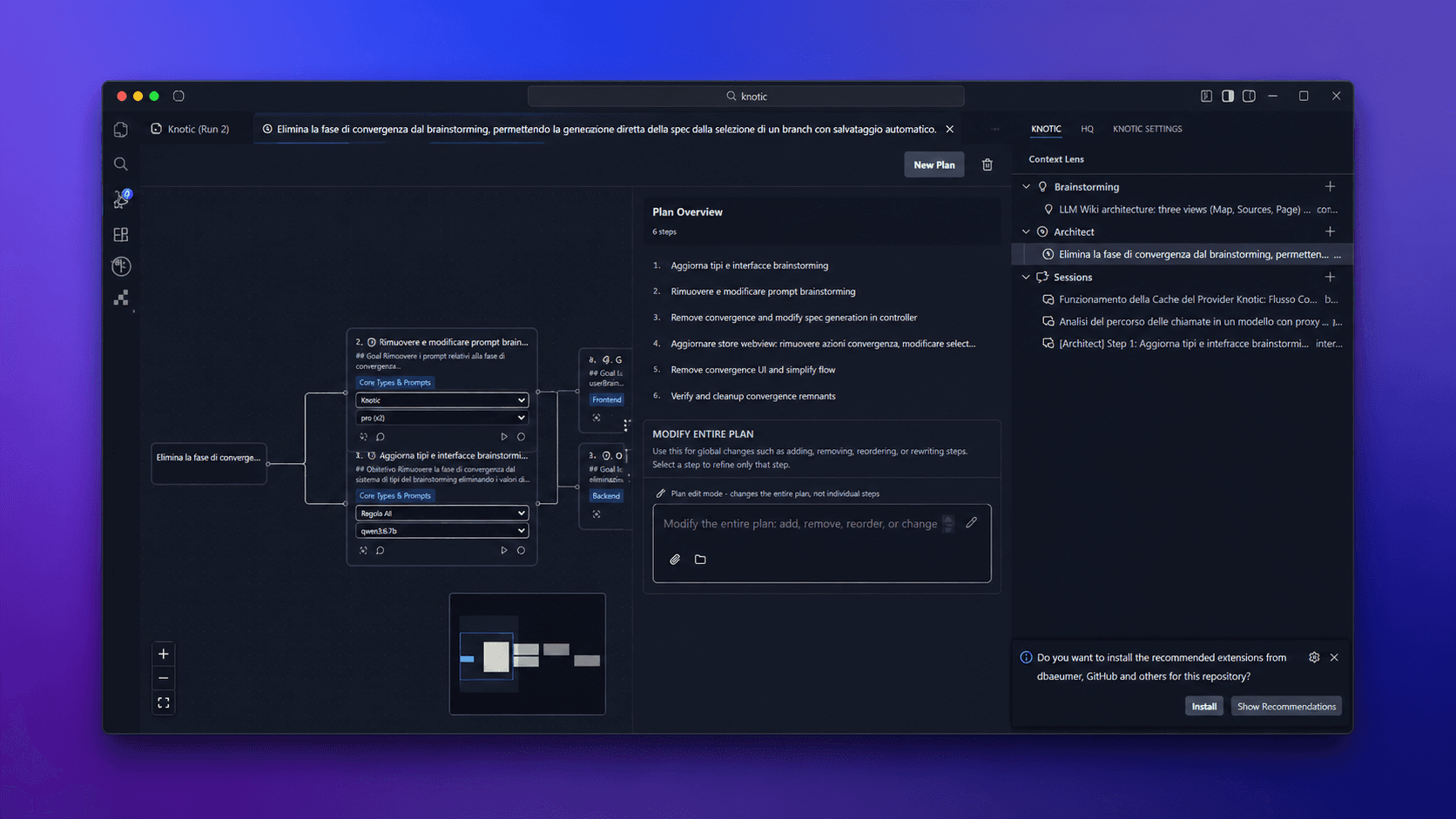
Turn plans into governed execution
Move from shared specs to tracked steps, diffs, and recoverable delivery inside the same AI workspace.
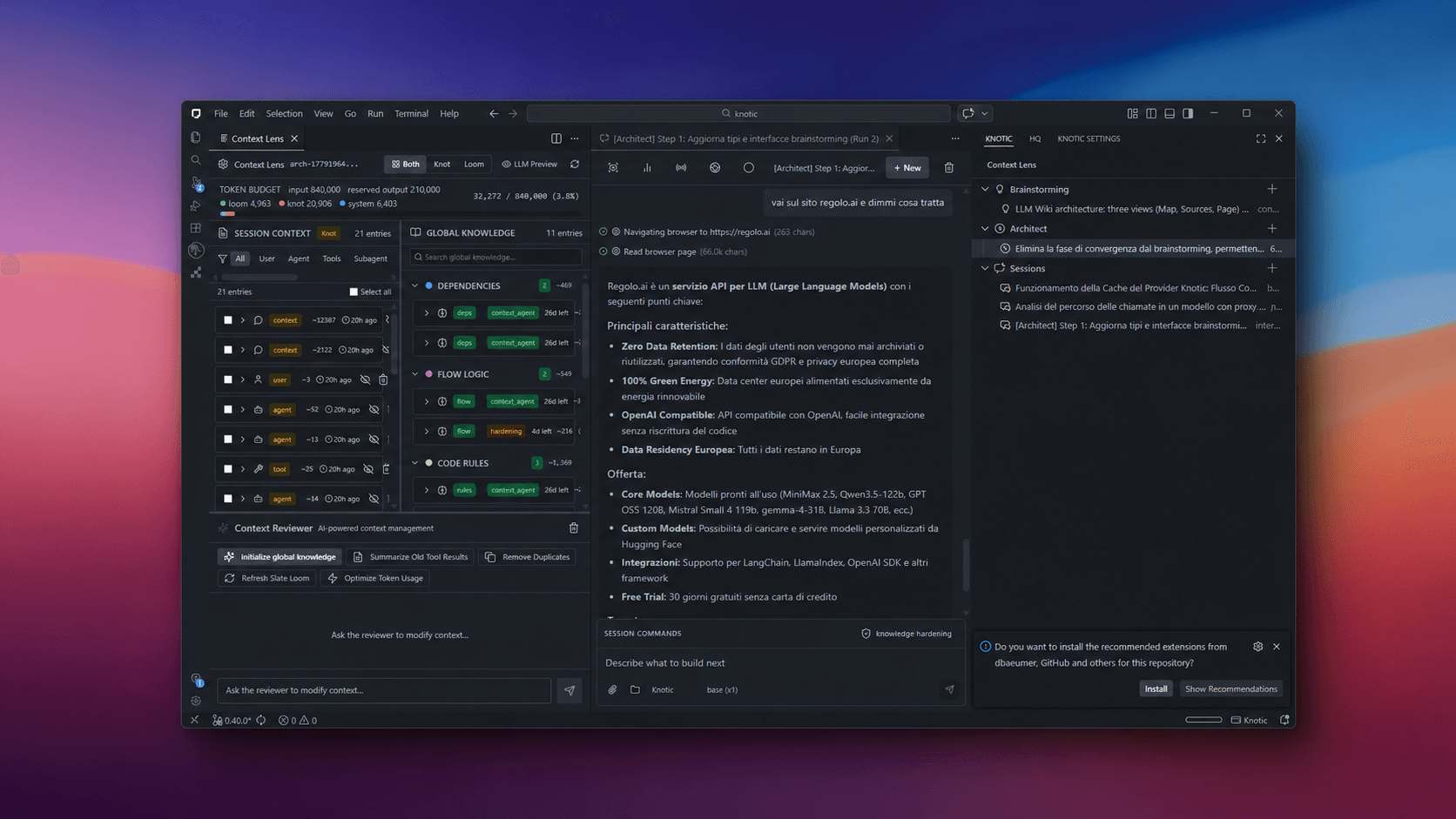
Context Lens: see the prompt before you send it — no more blind context assembly
Skills as Code + repo-native memory: stop re-explaining your codebase to AI
No time-window rate limits. Multi-provider routing. Per-call cost visibility.
Why teams switch
AI coding works. Blind context, rate limits, and tribal knowledge don't.
Developers hate not knowing what the model sees, getting locked out mid-sprint, and re-teaching the same rules every session. Leads can't audit what's being sent, spent, or learned. Knotic replaces all of it with one governed surface: inspectable context, no cooldowns, shared knowledge, and per-call visibility.
Operating gap
Blind context assembly — you send prompts without seeing what the model actually receives.
Mid-sprint lockouts — hidden rate limits that stop work at the worst possible time.
Tribal knowledge — every dev re-teaches the same rules and nobody versions what works.
Blind context, rate limits, and lock-in
You don't know what the model sees until it's too late. Hidden payloads, arbitrary cooldowns mid-sprint, and provider lock-in that makes every month a re-buy decision. Developers hate it. Leads can't audit it.
Every dev re-teaches the same rules
Useful prompts, project knowledge, and hard-won fixes vanish into private sessions. Each developer re-explains the codebase to AI from scratch. Teams cannot reuse, version, or govern their best workflows.
Inference spend stays invisible
No one sees what the model received, which provider handled a call, or what it cost. Without per-call telemetry, teams cannot optimize quality, budget, or privacy at delivery speed.
Strategic lever
Context Lens & BYOK
Inspect every payload before it ships. Curate context, control tokens, and keep your keys. No black-box assembly, no forced provider.
Strategic lever
Skills as Code + repo memory
Stop re-explaining your codebase. Save workflows, prompts, and project knowledge as versioned repo artifacts — shared, reviewed, and reusable across the team.
Strategic lever
No lockouts + per-call telemetry
No time-window rate limits. Multi-provider routing. Per-call visibility into cost, latency, and tools used — so teams can govern spend instead of guessing.
Features
One workspace. Governed AI delivery. No lockouts.
From seeing every prompt before it ships (Context Lens) to team-wide knowledge that lives in your repo (Skills as Code + repo-native memory), Knotic replaces fragmented plugin stacks with a single governed AI delivery loop for developers, teams, and regulated environments.
What teams gain
See the exact payload, token budget, and memory blocks before you send — no more blind context assembly.
Store reusable workflows and team knowledge in the repo, reviewed in Git, shared as versioned assets.
Per-call telemetry on cost, latency, tools, and provider — no hidden spend, no time-window lockouts.
Core advantages
The foundations that make one shared AI workflow credible for serious teams.
Core advantage
Privacy-first architecture
Project memory and shared knowledge can live inside the repository, local providers are supported, and teams are never forced to send code into a proprietary backend.
Core advantage
Multi-provider runtime
Run Knotic, OpenRouter, GitHub, Anthropic, OpenAI, or local endpoints, then route different AI roles to different models without changing the team workflow.
Core advantage
No time-window rate limits
Knotic inference is designed for throughput without hour or day lockouts, so teams are not forced into arbitrary cooldowns in the middle of delivery.
Product surfaces
The shipped surfaces that move teams from ideation to execution without losing context.
Product surface
Context Lens
Inspect the exact payload, token budget, and memory blocks before sending. Clean, reorder, or trim context before it burns tokens, leaks signal, or inflates cost.
Product surface
Skills as code
Store reusable workflows in the repo, review them in Git, and let teams share operating knowledge as versioned artifacts instead of scattered prompts.
Product surface
Architect mode
Turn complex requests into step-by-step plans, execute them in sequence, keep state between steps, and avoid the unreadable mega-prompt mega-patch cycle.
Platform surface
HQ Monitoring
Track tokens, cost, latency, tools used, and files touched per call, per agent, and per skill so leads, finance, and security can optimize spend instead of just observing it.
Platform surface
Local model manager
Download and cache GGUF models, run local completions, and support air-gapped teams that need a serious path to private inference.
Platform surface
Remote session sharing
Collaborate on live AI sessions with permission controls for view or interactive access, turning AI work into a team surface instead of a solo chat log.
Developer continuity
Full VS Code fork
Keep the editor foundations teams already depend on, including extensions, keybindings, and themes, while replacing fragmented AI add-ons with one governed workspace.
Why Knotic wins
Cursor, Claude Code, Windsurf — none let you see the prompt before you send it.
Every other AI IDE ships blind context with hidden rate limits. Only Knotic gives you Context Lens to inspect every payload, Skills as Code + repo-native memory to stop re-explaining your codebase, and per-call telemetry to govern spend and throughput.
Context Lens
See the prompt before you send it. Inspect token budget, memory blocks, and freshness signals before the model spends any of it.
Skills as Code
Stop re-explaining your codebase. Versioned, shared workflows in the repo — reviewed in Git, reused across the team.
No lockouts, full telemetry
No time-window rate limits. Multi-provider routing. Per-call cost, latency, and tools visibility so teams can govern spend.
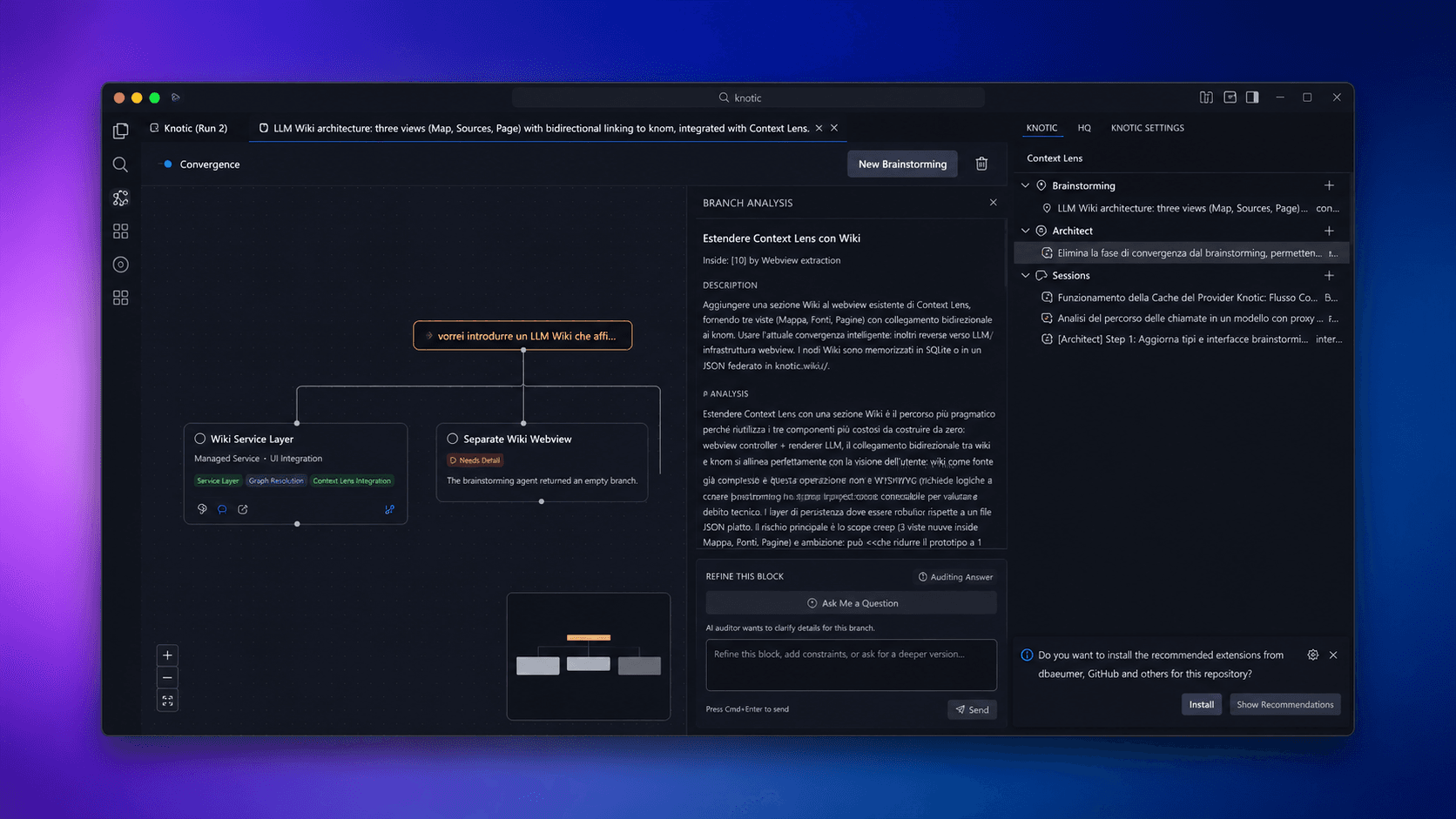
Integrated brainstorming, planning, execution, and monitoring
Privacy-first architecture
Explicit multi-provider runtime
No time-window rate limits on managed inference
Inspectable payload before send
Repo-versioned shared knowledge
Structured multi-step execution
Per-call telemetry and cost visibility
Local or air-gapped deployment path
FAQ
Questions developers and leads ask before trusting another AI IDE.
Developers want to see the prompt before it ships, avoid rate limits, and keep their keys. Leads want shared knowledge, per-call telemetry, and a credible path past compliance. Knotic delivers both.
Buying lens
Can I see every prompt before it goes to the model, not after?
Can the team version and reuse knowledge instead of re-teaching the same rules?
Can I govern spend, throughput, and provider choice without hidden lockouts?
Knotic is a VS Code-based AI IDE, not a single assistant panel. Brainstorming, planning, execution, context inspection, provider routing, shared knowledge, and telemetry live in one workspace.
Knotic combines what the market usually splits apart: privacy-first architecture, explicit multi-provider routing, repo-versioned knowledge, inspectable execution, and no time-window rate limits on Knotic inference. It is built for governed software delivery, not just faster autocomplete.
Yes. Knotic is designed for repo-native memory and supports local providers. Teams can keep project knowledge in .loom and .knot artifacts, version them in Git, and avoid forcing code or memory into a closed vendor backend.
Yes. Knotic supports Knotic, OpenRouter, GitHub, Anthropic, OpenAI, and local runtimes. Teams can use BYOK, assign different providers to different roles, and change vendors without rewriting the way they work.
Project memory, session context, Skills as Code, specs, and shared sessions can become repository artifacts or governed team surfaces. The useful parts of AI work stop living only in private chats.
Yes. Knotic makes the payload, provider, token budget, cost, latency, and tools visible. Context Lens helps trim noisy context before sending, while HQ Monitoring shows which workflows are actually spending inference budget so teams can optimize usage instead of guessing.
It means managed Knotic inference is not built around arbitrary hour or day lockouts. Instead of getting blocked by a cooldown because you hit a hidden threshold, teams pay for actual consumption and keep moving.
Yes. Knotic is designed around reusable team knowledge, repo-versioned skills, per-call monitoring, shared governance, and remote session sharing. The product story is enterprise-friendly from the start, not retrofitted later.
Yes. Knotic is a full VS Code fork, so teams keep the editor foundations they already rely on while upgrading the AI layer with better governance and observability.
Knotic is strongest for product teams, agencies, and enterprise engineering groups that already use AI coding but need better privacy, better control, and a credible path past lock-in and compliance objections.
Download the beta
The AI IDE you can actually govern.
See every prompt before it sends. Own your context with BYOK. No more hidden rate limits mid-sprint. Knotic gives developers Context Lens, Skills as Code, repo-native memory, and per-call telemetry in one VS Code-based AI IDE. Turn AI coding into a governed team workflow.
Context Lens · No lockouts · Skills as Code · BYOK